

 UA
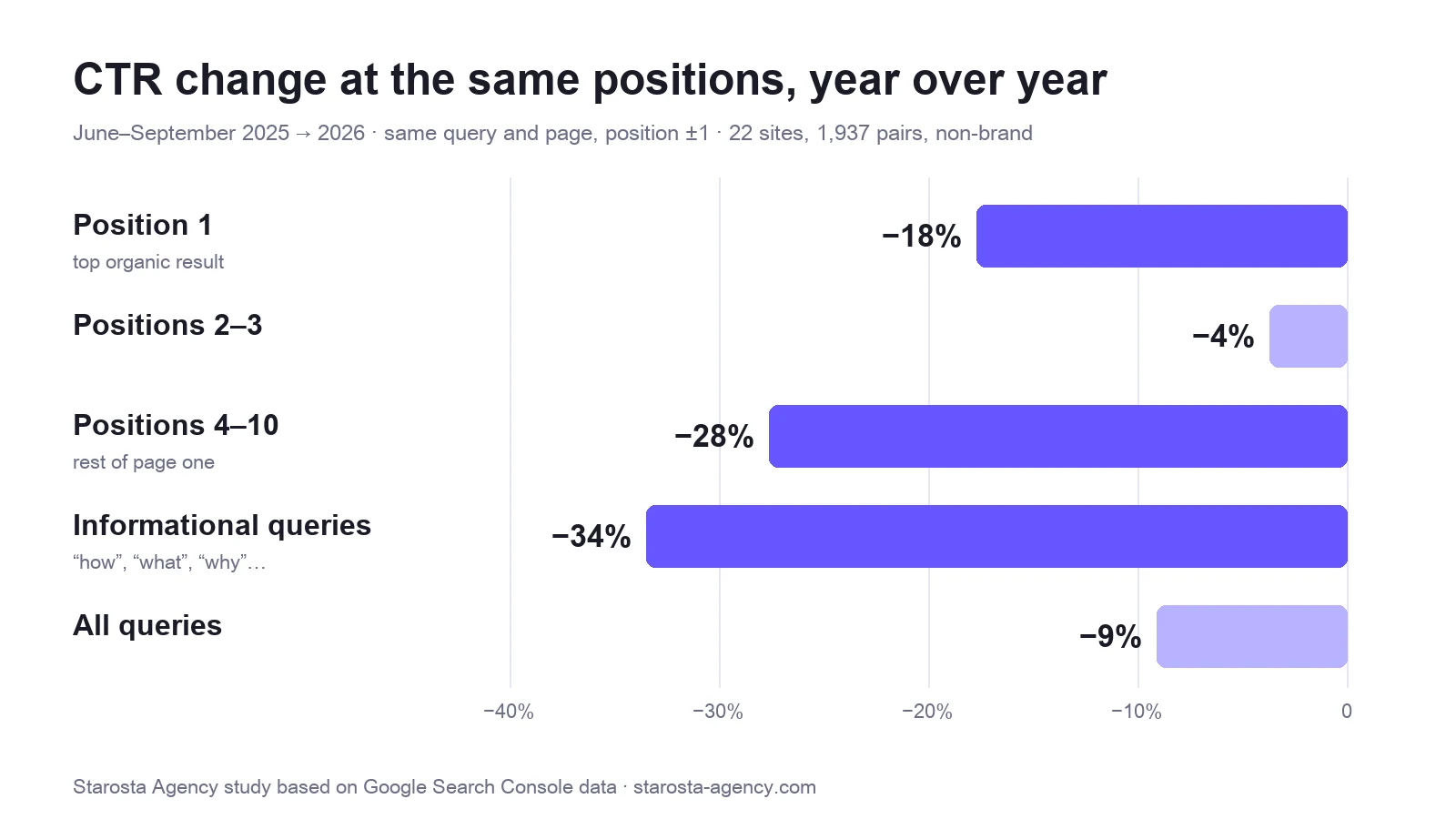
In short: we compared the same query–page pairs at the same Google positions in June–September 2025 and June–September 2026 — one year after AI Overviews launched in Ukraine. Across 22 websites (1,937 pairs, about 1.4 million impressions), CTR fell by 18% in position 1 and by 28% in positions 4–10, while positions 2–3 barely changed (−4%). Informational queries (“how”, “what”, “why”) took the biggest hit, at −34%. Yet the overall CTR of the same sites rose over that period, so the drop is easy to miss if you only look at Search Console totals.
Why we ran the numbers
AI Overviews — the AI-generated answer box above the regular Google results — became available in Ukraine on 21 May 2025, when Google expanded the feature to more than 200 countries and over 40 languages, including Ukrainian. In August 2025, AI Mode, a separate AI-powered search mode, also launched in Ukraine. Since then, clients keep asking us the same question: “Our rankings are going up, but clicks aren’t. Is it something we’re doing, or is it happening to everyone?”
To answer with numbers rather than gut feeling, we pulled Google Search Console data for the websites we manage and measured how CTR (clicks divided by impressions) changed for the same queries at the same positions one year later.
Methodology
- Data: Google Search Console data from 22 websites: online stores, service businesses, and medical, legal, educational and cultural projects. Most target the Ukrainian market; some target Europe and North America. We don’t disclose site names or queries and publish only aggregated figures.
- Periods: June–September 2025 versus June–September 2026 — matched for length and season.
- Like-for-like comparison: we kept only query–page pairs that had impressions in both years and whose average position moved by no more than 1. This removes the effect of ranking growth, new pages and a changing query mix. That leaves 1,937 pairs with 741k impressions in 2025 and 642k in 2026.
- Non-brand only: queries containing the company or domain name were excluded — they behave differently.
- Positions: page one only (1–10), based on the pair’s average position in the base year.
Finding 1: CTR fell 18% in position 1 and 28% in positions 4–10
| Position | Pairs | CTR 2025 | CTR 2026 | Change |
|---|---|---|---|---|
| 1 | 336 | 12.2% | 10.0% | −18% |
| 2–3 | 431 | 11.8% | 11.3% | −4% |
| 4–10 | 1,170 | 1.37% | 0.99% | −28% |
| All (1–10) | 1,937 | 5.47% | 4.97% | −9% |
Two groups of positions were hit hardest. Position 1 — most likely because the AI answer above it resolves the user’s question before the click. And positions 4–10, which the AI box, ads, maps and other SERP features push below the fold. Positions 2–3 held up: someone who wants more than the AI answer tends to click one of the top links, including those cited in the AI Overview itself. These explanations are hypotheses: Search Console does not show which queries triggered an AI Overview, so we cannot attribute the drop directly to AI Overviews from this data.
For the websites targeting the Ukrainian market (11 of 22), the pattern is the same and even sharper for positions 4–10: position 1: −20% (22.8% → 18.3%), positions 2–3: −3%, positions 4–10: −33% (1.43% → 0.95%).
Finding 2: CTR on informational queries fell by a third
We split queries by wording: informational (containing question words such as “how”, “what”, “why”, “how much”, “which” — in Ukrainian, Russian and English), commercial (“buy”, “price”, “order”, “delivery”, city names) and other — mostly product, category and service names without modifiers.
| Query type | Pairs | CTR 2025 | CTR 2026 | Change |
|---|---|---|---|---|
| Informational | 230 | 2.14% | 1.42% | −34% |
| Commercial | 172 | 12.2% | 11.4% | −6% |
| Products, categories, services | 1,535 | 5.02% | 4.95% | −1% |
That is no surprise: “how” and “what” questions are exactly where Google most often answers with an AI box, so the user no longer needs to visit a website. Queries with the intent to buy or order lost far less — an AI answer cannot take an order in place of the store. The samples by query type are smaller than by position, so treat these figures as showing direction rather than exact values.
Finding 3: CTR fell on 8 of 13 sites and rose on 5
Among the 13 websites with enough data for comparison (at least 1,000 impressions in each year), CTR at the same positions fell on 8 and rose on 5. The median change was −8%. In other words, AI search does not “take clicks from everyone equally”: the outcome probably depends on the topic, the query mix and how much better a page answers the question than the AI does.
The aggregate trap: site-wide CTR can grow while CTR at the same positions falls
The overall CTR of the same 22 websites for June–September did not fall — it rose from 2.33% to 2.55%. Clicks grew by 31% and impressions by 19%. The reason is that rankings improved over the year and the sites gained new pages and queries. If you only look at overall CTR in Search Console, it is easy to conclude that AI Overviews have not affected you. A like-for-like comparison of the same queries at the same positions shows otherwise: the same position now brings fewer clicks than it did a year ago.
What businesses should do about it
- Aim for the top 3, not just “page one”. CTR in positions 4–10 fell by almost a third, so a page-one ranking is worth noticeably less than it was a year ago. Plan SEO so that key pages reach positions 1–3.
- Write informational content that AI answers are likely to cite. A direct answer at the top, clear definitions, a structure with subheadings, tables, FAQs and original data. When an AI Overview cites your page, your brand gets visibility even without a click. That is what GEO — optimization for AI search is about.
- Put more weight on commercial pages. Queries with the intent to buy or order lost the least. Dedicated service and category pages, links to them from blog posts and solid internal linking deliver more than yet another informational article.
- Measure CTR on the same queries and positions. Site-wide CTR mixes ranking growth, new pages and seasonality. Compare specific queries at the same position year over year — that is where the real impact of AI search shows.
- Look beyond clicks. Search impressions, brand mentions in AI answers and branded search demand also show whether your SEO works, even though some searches now end without a visit to your site.
Limitations
- The base period (June–September 2025) already falls after the AI Overviews launch in Ukraine, so the full effect since launch is probably larger.
- Search Console does not show which queries triggered an AI Overview, so linking the CTR drop to AI Overviews is a reasoned assumption rather than a direct measurement. Ads, snippet changes and other SERP features also affect CTR.
- The sample is 22 websites we manage, not the whole market. The largest site accounts for up to 22% of impressions in the sample.
- Query type was determined by the words in the query, without manual labelling.
Want to know how many clicks AI search takes from your site and which queries to refocus your content on? We run this analysis on your own Search Console data as part of a GEO audit.
Launch sources: Mezha — AI Overviews in Google now available in Ukraine; Mezha — Google introduces AI Mode in 180 countries, including Ukraine. Study data: Google Search Console of 22 websites managed by Starosta Agency, June–September 2025 and 2026. If you cite this study, please link to this page.
Frequently Asked Questions
Do AI Overviews reduce clicks from Google?
Our data says yes, but unevenly. For the same queries at the same positions, CTR fell by 9% on average over the year: by 18% in position 1, by 28% in positions 4–10 and by 34% for informational queries. Positions 2–3 and commercial queries lost the least.
Why hasn’t my site’s overall CTR dropped?
Because overall CTR mixes many effects: ranking growth, new pages, a changing query mix and seasonality. In our sample, the sites’ overall CTR even rose from 2.33% to 2.55%, although clicks at the same positions went down. To see the impact of AI search, compare the same queries at the same position year over year.
Which queries lose the most clicks to AI Overviews?
Informational ones — “how”, “what”, “why” and “how much” questions that AI answers right in the search results. In our study their CTR at the same positions fell by 34%. Queries with the intent to buy or order lost about 6%, and product, category and service names about 1%.
How can I protect my traffic from AI search?
Push key pages into the top 3 rather than just onto page one; write informational content that AI answers are likely to cite (a direct answer, clear structure, FAQs, original data); put more weight on commercial pages; and measure CTR on the same queries and positions instead of site-wide CTR.
When did AI Overviews launch in Ukraine?
On 21 May 2025, when Google expanded AI Overviews to more than 200 countries and over 40 languages, including Ukrainian. AI Mode, a separate AI-powered search mode, launched in Ukraine in August 2025.


